“The problem is, the brain I’m using to dissect this world is a brain formed by it. We’re born into confusion, and we get the blessing of letting go of it. I think this shit by day. And then night comes and it’s like, ‘Fuck it, let’s drink.’”
I hate it when i see someone asking ‘so wait, if a trans woman like women, is she gay or straight?’ and suddenly a dozen people jump on their ass for being ignorant or transphobic or whatnot- when all they had to do was answer the question. All you had to is go ‘She’s gay!’, and the person would go ‘oh, cool!’ and now they know. They just had a positive interaction with trans folks.
But if you belittle them, now they’ve learned they’re punished for asking. They’re punished for wanting to know, for wanting to learn, and for coming directly to the people who live that life instead of just going to google. And they come away not having learned anything except that those people were dicks to them.
Everyone is clueless at some point. When I was 10, I was homophobic. I was a kid, raised around homophobic parents in a homophobic country. But one day i decided hey, i want to learn, and i found some gay friends and I asked them some questions.
Do you think i’d be here; if they had told me that i was an ignorant fuck, that i should pull my head out of my ass, that I shouldn’t have asked those things?
It was thanks to them that I learned and grew as a person, because even though i was a stupid homophobic kid with some admittedly stupid questions, they answered them, because everybody starts clueless.
It doesnt matter how young or old or who they are either- everyone starts somewhere. And lord knows, I’ve had some people ask me some stupid questions. My government teacher came to me yesterday and asked me that exact question i mentioned above, and I answered it. He’s a 40-something year old dude. He’s trying to learn.
My little brother is 9, and asked me once if being gay meant that I wanted to kiss every girl i met. Was it a stupid question by my standards? yes. Did I answer it like it was any other normal question? Also yes.
Insulting people who are trying to learn is one of the dumbest things I’ve ever encountered. It can literally mean the difference between someone becoming part of the community or trying to take us down. We judge that; we control how we educate.
Do yourself a favor and educate. Everyone starts somewhere, and it’s our job to help them along, not tear them down.
It’s also Bucky being more than a little upset that they turned his gentle, harmless friend—who Bucky wanted to PROTECT from the horrors of war—into a fighting machine.
was that really necessary
it’s also Bucky realizing that he can no longer protect his best friend no matter how hard he tries. he’s utterly helpless now, even after the war is over. they’ll always be wanting steve to fight this or that, and bucky won’t be able to do a darn thing to protect him.
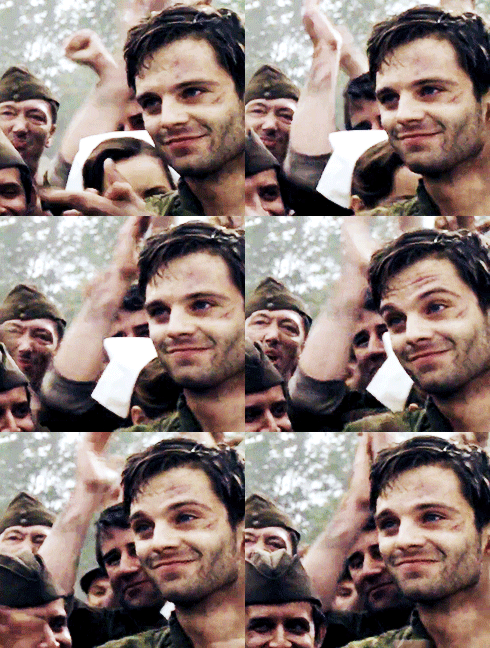
It’s also Bucky taking the 5 seconds he has of Steve not paying attention to him so he can allow himself to process all these emotions without worrying Steve. If you watch Bucky through the movies, you’ll notice he always makes sure to look like he’s 100% fine if other people are looking at him. Fighting with Steve, but smiling at their dates. Recently tortured, but walking confidently by Steve’s side. Basically a mess, but all “Let’s hear it for Captain America!” It’s a pattern, really. Even in the flashback in CATWS, you can see he looks a lot less confident when Steve isn’t looking at him than when Steve is.
Also, Seb has mentioned that researching WW2, what left the deepest impression was how quickly everybody dies. You get attached to someone only to watch their heads being blown up in front of you the next day. I’m sure this influenced how he chose to act this scene. Because you can bet by the time this scene takes place, Bucky has seen many people – hell, maybe even friends – die, and recently, he’s had to see his whole unit be killed or captured by HYDRA. This certainly plays a role here. It’s not just a general sense of “I can’t protect Steve anymore,” it’s more like “I don’t know if Steve will live till next week.” It’s very real, very immediate. It’s a concrete prediction more than a vague fear. And if Steve’s survives, there’s still the fact Bucky knows what’s like to be changed by war, and Steve will be changed by it, which Bucky certainly hates. Either way, he loses the Steve he knew, even more than he’s already lost, with the whole “Steve Rogers is suddenly a super soldier” deal.
I’d say this scene is wartime Bucky in a nutshell. He handles the entire crowd and this whole Captain America propaganda thing without hesitation, he smiles at Steve and makes sure Steve enjoys the moment instead of pulling some “I did my duty” bullshit, and only then he allows himself to be overwhelmed by the fear that comes with being able to think 48923740 worst case scenarios in two seconds. If we can trust interviews with cast and crew, this eventually becomes his role in the war, basically – he thinks fast and does his job protecting Captain America and the missions, he takes care of Steve on a personal level by shielding him from the worst of the war as much as he can, and only then, if there’s time and Steve isn’t looking, he thinks about how the war is affecting him.
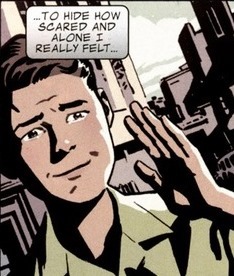
But anyway, overall, this scene is about overwhelming loss of everything Bucky knows, as well as an attempt to hide this as well as he can. And I don’t think it’s a coincidence that in the 4th and 5th gifs, Seb looks a lot like comics!Bucky does when he says goodbye to his younger sister, thinking he’ll never see her again and almost breaking down in tears, but unwilling to show her he’s scared. For your reference:
WAS ANY OF THIS REALLY NECESSARY
Always reblog
MCU actors in general and Seb Stan in this instance doing yeoman’s work to bring layers of depth and characterization above and beyond the script in a series of microexpressions. A++
I have never been more moved, happy, sad, angry, consumed, than when I read this
The sex scenes alone? Hot damn!!
Please collab again because I don’t think I can handle reading anything else now. You’ve both ruined me lol
OMG OMG OMG
Thanks a million for this shout-out, @jewels2876 *dashes away happy tears after sobbing into her morning tea*
Thalia is so much a part of our life, and writing her with @avenger-nerd-mom was one of the best things I ever did. I’m so happy that you enjoyed the story with all its emotions and sexytimes.
The good news is that we missed our girl and her professors so much that we’ve decided to let her speak again. So, there will be a sequel. Stay tuned for a Christmas special in December and more of Thalia, Tom and Chris next year.
Write them to show what’s healthy. Write them to show what’s unhealthy.
Write them because problematic behaviors exists, and writing is a medium to explore and show– to teach and make the reader think. Shying away from these topics only creates ignorance.
I see so many people telling writers to avoid anything that could be problematic, like writing about it is supporting it. They fail to see the importance of writing with depth and meaning.
Writing has always been about conveying thoughts and ideas without fear of censorship. Being able to present problematic situations in a healthy way is important.
If I ever stop reblogging this topic, assume I’m either dead or have been assimilated by the mindless masses.
I have a hard time writing in direct lies. That is to say, I struggle to write things that I do not myself believe in. Like, writing a character who believes in guns solving the world’s problems. Or writing characters who’ll directly use the ignorance of their audience to their advantage. It’s in my nature to want to show those kinds of characters as being the wrongful liers that they are.
But a good story needs those characters, those wrongful beliefs, and those problematic attitudes. But more than that, a good story needs to treat those attitudes as if they were right. Because some of your audience is going to agree with those characters. They’ll believe in those thoughts, those lies. And if you try to sell them as being a lost cause from the get-go, you’ll lose your audience.
But if you treat them seriously you’ll change their minds.





 avenger-nerd-mom